

Guides · Guide
How to stage a house for sale, room by room
Stage a house in four passes: declutter (cut what's on shelves, counters and in closets by about half), depersonalize, neutralize bold colors and busy bedding, then arrange the furniture and light each room so it has one clear purpose. Start with the rooms buyers' agents rate most important to stage: the living room (37%), the primary bedroom (34%) and the kitchen (23%), according to NAR's 2025 Profile of Home Staging. With your own furniture, most of it costs little more than time.
By Emil Thomsen, Founder of October · Updated
Reading on Google? Add October to your Preferred Sources to see our guides more often.
What staging does, and what it doesn't
Staging means setting up a home so buyers can picture living in it: less stuff, nothing personal, furniture that shows what each room is for and how big it is, and light everywhere. It is different from photo-day prep (opening blinds, hiding the bins, moving the cars), which our real estate photoshoot prep checklist covers. Staging comes first and lasts for every showing.
The best data comes from NAR's 2025 Profile of Home Staging, a February 2025 survey of 1,266 Realtors. It measures what agents report, not sale prices:
- 83% of buyers' agents said staging made it easier for a buyer to picture the property as a future home. Only 12% said it had no effect on buyers' view of the home.
- 17% of buyers' agents said staging raised the dollar value offered by 1–5% compared with similar unstaged homes; 41% said it made no difference.
- Among sellers' agents, 30% saw a slight decrease in time on market for staged homes and 19% a great decrease; 17% saw no effect.
- 51% of sellers' agents don't stage homes themselves but tell sellers to declutter and fix faults, which is what most of this guide is about.
The Real Estate Staging Association (RESA) publishes results from homes its members staged: in the first half of 2026, an average sale-to-list ratio of 111% across 175 homes and 10 days on market across 170. RESA itself notes that these are the homes stagers chose to report, and that the figures don't isolate staging's effect. Treat them as an upper bound, not a promise.
Cost in one line: in NAR's survey, agents who used a staging service spent a median of $1,500, against $500 when they staged a home themselves. The full breakdown is in our home staging cost guide.
What to stage first
If you only have a weekend, spend it where buyers look hardest. NAR asked buyers' agents how important it was to stage each room, and sellers' agents which rooms they usually stage:
| Room | Buyers' agents: "very important" to stage | Sellers' agents who stage it |
|---|---|---|
| Living room | 37% | 91% |
| Primary bedroom | 34% | 83% |
| Kitchen | 23% | 68% |
| Dining room | 17% | 69% |
| Yard or outdoor space | 17% | 31% |
| Bathroom | 13% | 47% |
| Children's bedroom | 9% | 22% |
| Guest bedroom | 7% | 22% |
| Home office | Not asked | 36% |
So the order is: living room, primary bedroom, kitchen, then dining room and the outside, then bathrooms, then the rest. Every room still gets the declutter and clean pass below; the order only decides where the extra effort goes.
The four passes for every room
Do these in order, through the whole house, before you move a single piece of furniture. In NAR's survey, the improvements agents most often recommended before listing were decluttering (91%), cleaning the whole home (88%), improving curb appeal (77%), minor repairs (75%), carpet cleaning (74%), depersonalizing (72%), paint touch-ups (67%) and painting walls (57%).
- Declutter. "When in doubt, take it out" is the rule one stager gave Redfin. Another suggested cutting what's in closets by about half and clearing pantries, cabinets and bookshelves too, because buyers open them. Box it and move it to a garage, a friend's basement or a storage unit; don't stuff it all into one closet, or buyers will think the house lacks storage (Bob Vila).
- Depersonalize. Family photos, diplomas, religious and political items, collections, kids' names on walls, the fridge door. Swap family photos for landscapes or simple art. It also keeps your family off the internet when the listing photos go up.
- Neutralize. Repaint bold or very dark walls in a soft neutral, and switch to plain, light bedding and towels. Keep color in a few pillows, a throw or a plant rather than on the walls.
- Clean and fix. Walls around switches and door frames, grout and caulk, baseboards, windows, carpets. Then the small repairs: loose handles, dead bulbs, dripping taps, scuffs. Air the house out before every showing; Bob Vila suggests opening the windows for at least 10 minutes.
Arranging furniture: purpose, flow and scale
Staged furniture is a prop. Its job is to show what a room is for and how big it is, not how you live in it.
- One purpose per room. A bedroom with a desk, a treadmill and a sofa reads as storage. Pick the use buyers expect, and move the rest out or to the room where it belongs.
- Start from what's there. Stagers working in occupied homes decide piece by piece what stays, what moves to another room and what goes, before adding anything (Redfin, September 2026).
- Face the focal point. Arrange seating toward the fireplace, the big window or the view, and in a social group where people could talk to each other (Redfin, Bob Vila).
- Clear the path. Buyers should be able to walk in and through a room without stepping around furniture. A stager told Redfin to study the room's shape, traffic flow and focal point so buyers are drawn in rather than stopping in the doorway.
- Match the scale. Oversized pieces shrink a room, but don't strip it bare either: an empty room is harder to judge. A Northern Virginia agent told HomeLight that a 98-inch sofa will overwhelm a 700-square-foot condo; a queen bed beats a California king in a small bedroom.
- Size the groupings to the room. Depending on its size, a living room may need one sofa, a coffee table and an accent chair, or two sofas and two chairs; a very large one, two seating areas on two rugs. In an open plan, use furniture and rugs to define the living, dining and kitchen zones (Redfin, September 2026).
Light and color
Light makes rooms look bigger, cleaner and newer, and it costs almost nothing.
- Open every window covering. HomeLight's condo guide suggests taking down heavy drapes and pulling blinds all the way up; sheers pushed to the sides are fine.
- Every bulb working, one color per room. ENERGY STAR's bulb guide explains that a lower Kelvin number gives warmer, yellowish light and a higher one cooler, bluer light, and calls soft and warm white ideal for most indoor uses. Mixing a warm bulb and a daylight bulb in one room looks like two rooms.
- Bright enough. Judge brightness by lumens, not watts: ENERGY STAR equates a 60-watt bulb with 800 lumens. Add a lamp to any dark corner.
- Neutral, not stark. HomeLight's guide recommends neutral whites and warns against sterile hospital white, naming Sherwin-Williams Alabaster and Benjamin Moore White Dove as examples. Soft blues, whites and taupes work in bedrooms (Redfin).
Room by room: do, don't and the 15-minute fix
The 15-minute fix is what to do before a showing or a photo when there's no time for more.
| Room | Do | Don't | 15-minute fix |
|---|---|---|---|
| Entry and front door | Clear shoes, coats and bags; one plant or vase of flowers; a rug to mark an entry if there isn't one | Crowd it with furniture or a coat pile | Sweep, new doormat, a potted plant by the door |
| Living room | Seating grouped toward the focal point; remove extra and oversized pieces; lamps in dark corners | Push everything against the walls, or strip it bare | Coffee table down to two or three items, cushions plumped, blinds up, every lamp on |
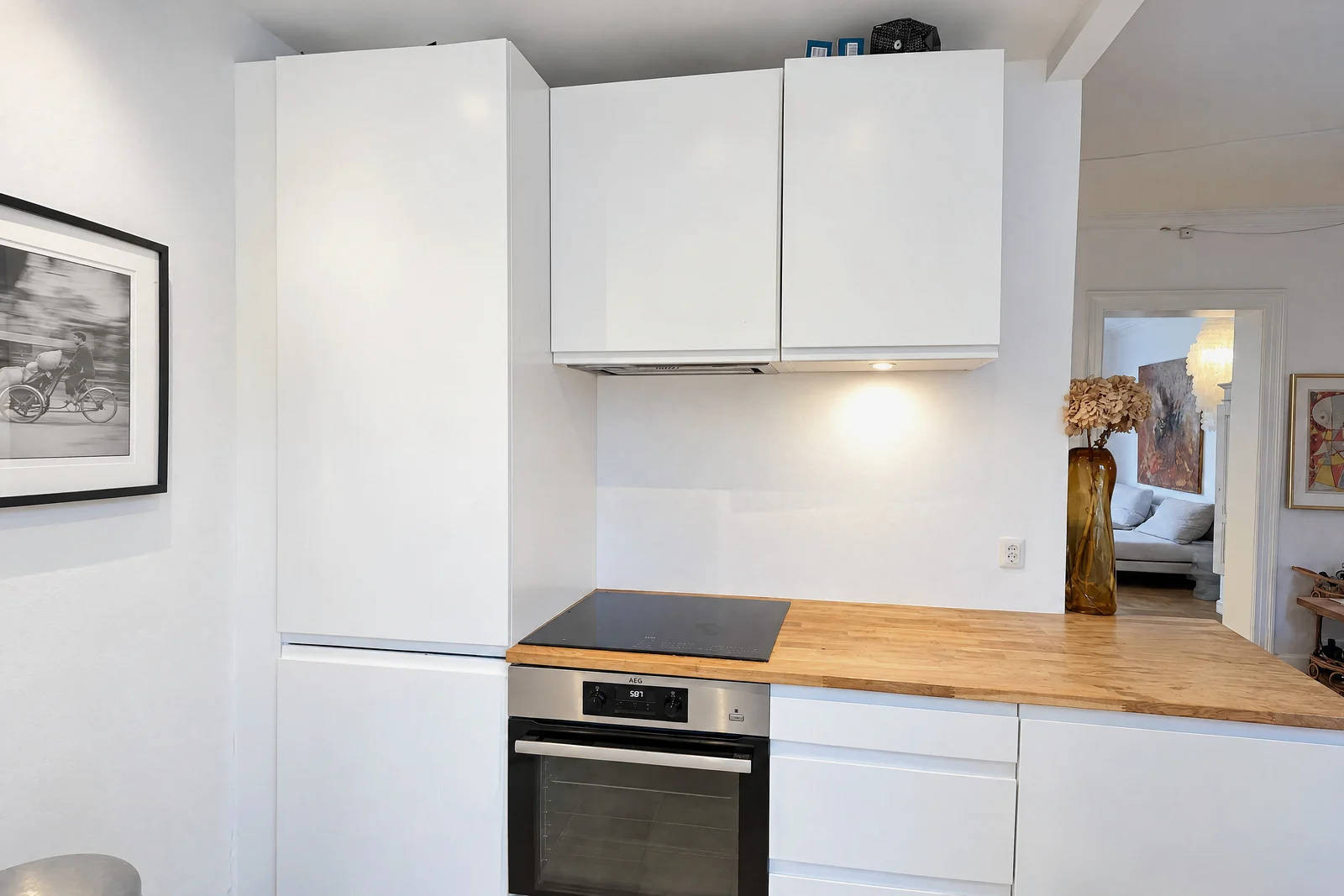
| Kitchen | Clear counters; store small appliances; empty the fridge door; fresh hardware if it's dated | Leave the dish rack, magnets, sponges or a strong cooking smell | Counters down to one bowl or vase, sink empty and dry, appliance fronts wiped |
| Dining room | A table and chairs that fit the room; a plain runner or centerpiece | Use the table as a desk or a mail drop | Clear the table, chairs pushed in evenly, one centerpiece |
| Primary bedroom | Bed on the wall facing the door; two nightstands with matching lamps; plain, full bedding | Leave exercise gear, laundry or a desk pile in it | Make the bed tightly, clear the nightstands, laundry out of sight |
| Other bedrooms | Give each one a clear use: bedroom, nursery or office | Leave it as a storage room | Clear the floor, make the bed, close the closet |
| Bathrooms | Deep-clean grout and caulk; one set of plain towels; a new shower curtain if the old one is tired | Leave toiletries, worn mats or a scale out | Clear the vanity, hang fresh towels, close the lid |
| Outside and curb appeal | Mow, edge, power-wash; paint the front door; clear house numbers; set out patio furniture | Leave bins, hoses, toys or dead plants | Sweep the path, pots by the door, porch light on |
Staging the kitchen
Buyers' agents ranked the kitchen third in importance (23% very important), and 68% of sellers' agents who stage include it. It is also the room where buyers open everything. Most kitchen staging is subtraction.
- Clear the counters almost completely. Put away the toaster, the kettle, the coffee machine, the knife block and the dish rack. Leave one bowl of fruit, fresh flowers or a small stack of cookbooks. "Less is more" is Redfin's summary.
- Empty the fridge door and top. Magnets, notes, kids' drawings and calendars all go.
- Edit the inside. Buyers open cabinets and the pantry. Box what you don't use every day so shelves and drawers look half full.
- Clean like an inspection. Stovetop, oven door, range hood filter, stainless fronts, handles and the sink. HomeLight suggests vinegar and a toothbrush for the stovetop.
- Small, cheap updates only. New cabinet hardware and fresh paint on walls or worn cabinet doors are what stagers suggest to Redfin and Bob Vila; a floor runner can freshen a tired floor. Don't start a remodel to sell.
- Light the work surfaces. Make sure every ceiling, pendant and under-cabinet light works and matches. In an open plan, use the same bulb color as the living area.
- Watch the smell. Bob Vila advises against strong-smelling meals before showings. Take out the trash and recycling.
- Vacant kitchen? A few stools at the island and a couple of small countertop accessories warm it up, according to a vacant-home stager featured by NAR.
Living room and dining room
The living room is the room buyers' agents rated most important to stage (37%) and the one sellers' agents stage most often (91%).
- Living room: pull seating into a conversation group around the focal point, take out the extra recliner or the second side table, and keep a few healthy plants (Redfin adds "not too many"). Refresh a worn sofa with a slipcover or new pillows (Bob Vila). Hide game consoles, remotes and cables; leave the TV if it's mounted, but off.
- Dining room: the table and chairs should fit the room's scale, with a clear path around them; a stager told Redfin to add a mirror, art or a buffet once the basics are right. Take out leaves and extra chairs if the table crowds the room. No dining room? A well-proportioned kitchen table or stools at a breakfast bar show where people eat.
Bedrooms and bathrooms
If you can't stage every bedroom, stage the primary bedroom: buyers' agents ranked it second (34%), and guest bedrooms last (7%).
- Primary bedroom: a stager quoted by Redfin recommends a queen bed where it fits, on the wall opposite the door and not in front of a window; full bedding; two nightstands with current lamps; a chair or bench at the foot of the bed; and art over the bed at least two-thirds the bed's width. Clear the closet floor and thin out what hangs in it.
- Other bedrooms: a bed made with plain bedding, one nightstand and a lamp is enough. A small spare room can be staged as an office with a desk and a chair, if that's how buyers in your area would use it.
- Bathrooms: make them feel clean and new. Scrub grout and caulk, replace a worn shower curtain and bath mat, put toiletries away in a cabinet or a basket, and hang one set of fresh towels (Bob Vila, Redfin). If the vanity area looks dated, stagers quoted by Redfin suggest a simple new mirror or an updated light fixture.
Entry, outside and curb appeal
77% of agents in NAR's survey recommend improving curb appeal, and 53% landscaping. Buyers see the outside first, in person and as the first listing photo.
- Remove dead plants, mow and edge, and power-wash the path, driveway and siding (Redfin).
- Paint or clean the front door, and replace a tired mailbox, house numbers or doormat.
- Put a pair of pots or a plant at the door; if there's a porch, a bench or a small bistro set.
- Clean the patio or deck and set out chairs and a table; in winter, clear leaves and snow from it (Bob Vila).
- Light the outside for buyers who drive past in the evening (Redfin).
- Inside the door, the entry should be empty except for one rug, a plant or a small table.
Staging an occupied home vs a vacant one
| Occupied (you live there) | Vacant | |
|---|---|---|
| Main job | Edit: remove, rearrange and depersonalize what you own | Add: bring in enough furniture to show scale and purpose |
| Where to focus | The rooms that most shape buyers' impression, not every room (Redfin) | Living room, primary bedroom, kitchen and dining first |
| Hardest part | Keeping it show-ready every day | Rooms look smaller and harder to judge empty |
| Cheapest route | Your own furniture, rearranged, plus boxes and a storage unit | Rented or borrowed key pieces, or virtual staging for the photos |
Living in a staged house. The stager keeps your furniture, but the daily upkeep is yours. A stager writing for NAR notes that stagers often give sellers a checklist and storage tips for a quick tidy before each showing, recommends a plan for showings on short notice, and suggests a weekly cleaning service to lighten the load.
Staging a vacant house. Don't leave it blank. A stager featured by NAR adds just enough furniture and accessories, such as plants, pillows, throws and tabletop pieces, for buyers to see how a room would fit together; painting isn't required. Furnish the living room, the primary bedroom and the dining area first. If you can't bring in furniture, virtual staging can show furniture in the listing photos, but buyers then walk into empty rooms: in NAR's survey, 57% of buyers' agents rated physical staging more or much more important to their clients, and only 18% said the same of virtual staging. Our guide to virtual staging vs empty room photos weighs it up, and the best virtual staging apps compares the tools.
Staging an apartment or condo
HomeLight puts the average condo at 1,200 to 1,400 square feet, about 1,000 less than a single-family home, so every piece of furniture counts.
- Smaller, slimmer pieces: a track-arm sofa instead of a rolled-arm one, armless accent chairs, a queen or double bed. Store or sell bulky furniture for the listing period (HomeLight).
- Fewer rugs: HomeLight's agent removes small rugs, including by the kitchen and bathroom sinks, because they break up the floor.
- Light fixtures in scale: mini pendants, track lights, glass table lamps and slim floor lamps.
- Stage the balcony or patio: a small bistro table and two chairs show it can be used.
- Sell the building too: if the association handles snow and lawn care, or there's a gym or a doorman, put that in the listing and photograph what you're allowed to.
- Plan furniture moves: building rules, elevator reservations and delivery windows can slow furniture moves in a condo (Redfin, September 2026).
Staging on a small budget
Most of what works is free or close to it. In rough order of effect for the money:
- Declutter and depersonalize: boxes and a few weekends.
- Deep-clean, including carpets, grout and windows.
- Rearrange the furniture you have, and move pieces between rooms.
- Replace every dead or mismatched bulb, and add a lamp or two.
- Plain white or light bedding and towels.
- Paint: touch-ups first, then any bold or very dark wall.
- New pillows or a slipcover for a worn sofa (Bob Vila).
- New cabinet and door hardware where it's dated.
- Curb appeal: mow, edge, power-wash, two pots of plants by a freshly painted front door.
- Fresh flowers or a bowl of fruit, the last thing before a showing or a photo.
For what a stager, a consultation or furniture rental would cost on top, see home staging cost.
After staging: the listing photos
The photos are where most buyers first see your staging, so shoot them when the house is at its best, and keep it that way for the first weekend of showings. Our guides to taking pictures of your house to sell and the photoshoot prep checklist cover the shot list and the last 10 minutes before the shoot.
If you'd rather not handle the camera, the October app guides the listing photos on an iPhone 12 or newer: it walks you through the house room by room, shows you where to stand and keeps the phone level. An AI image model then draws each finished photo from your capture, with a daylight look and loose items left out, and is told to keep the walls, floors, windows, fittings, built-in furniture and the view. Finished photos usually come back within a few hours. Check each one before you publish, and label it as AI-altered or digitally altered where your MLS requires; the unaltered originals are in your download. It's $49 a place (up to 6 rooms), and your first place is free.
For a vacant room, October also offers Empty room ($19) and Staged room ($29) per room, labelled as virtually emptied or virtually staged; keep that label where your MLS asks for it. See pricing.
Step by step
Walk the house as a buyer
Go through every room with a notepad and write down what you'd remove, fix, move or add. Start the list with the living room, primary bedroom and kitchen.
Declutter
Cut what's on counters, shelves and in closets by about half. Box it and move it out of the house, not into one closet.
Depersonalize
Take down family photos, diplomas, collections and religious or political items; clear the fridge door.
Clean and repair
Deep-clean walls, grout, carpets and windows, then fix loose handles, dead bulbs, dripping taps and scuffs.
Neutralize
Repaint bold or dark walls in a soft neutral and switch to plain, light bedding and towels.
Arrange the furniture
Give each room one purpose, group seating toward the focal point, clear a walking path and remove oversized or extra pieces.
Light every room
Open window coverings, make every bulb work and match its color within each room, and add lamps to dark corners.
Style lightly and keep it ready
Add a few plants, pillows and flowers, do the outside, then keep a daily routine so the house is ready for photos and showings.
Questions
How do I stage my house to sell on a budget?
Declutter, depersonalize and deep-clean first; they cost almost nothing and are what agents recommend most (91%, 72% and 88% in NAR's 2025 survey). Then rearrange the furniture you have, fix every bulb, use plain light bedding, touch up the paint and spend what's left on curb appeal and a few plants.
Which rooms should I stage first?
The living room, the primary bedroom and the kitchen. In NAR's 2025 Profile of Home Staging, buyers' agents rated them the most important rooms to stage (37%, 34% and 23% very important). The guest bedroom came last at 7%.
Does staging help a house sell?
Agents say it helps buyers more than it moves the price. In NAR's 2025 survey, 83% of buyers' agents said staging made it easier for buyers to picture the home as theirs; 17% said it raised offers by 1–5%, and 41% saw no difference in the dollar value offered. Among sellers' agents, 49% saw a slight or great decrease in time on market.
How do you stage a kitchen to sell?
Clear the counters down to one bowl or vase, put away small appliances, empty the fridge door, edit the cabinets and pantry so they look half full, and clean every surface. New hardware or paint is as far as most stagers go; don't remodel to sell.
Should I stage an empty house?
Usually, at least the living room, primary bedroom and dining area. Empty rooms look smaller and are harder to judge. If you can't bring in furniture, virtual staging helps the photos, but in NAR's survey only 18% of buyers' agents rated it more important to clients, against 57% for physical staging.
Can I live in my house while it's staged?
Yes; most sellers do. Stage with your own furniture, keep a short daily reset routine and a basket per room for quick pick-ups, and plan where you and your pets go during showings. Some sellers hire a weekly cleaner for the listing period.
What colors should I paint before selling?
Soft neutrals: warm whites, light grays, greige or pale blues. Repaint bold or very dark walls, avoid a stark hospital white, and test a sample under your own bulbs, which change how a color looks.
What's the difference between staging and photo prep?
Staging sets up the house for the whole listing period: decluttered, depersonalized, furniture arranged, rooms with a clear purpose. Photo prep is the last hour before the shoot: blinds open, lights on, bins and cars out of sight. See our photoshoot prep checklist.
Sources
- NAR, 2025 Profile of Home Staging (1,266 responses, February 2025)
- RESA: Home staging statistics and quarterly market insights (Q1 & Q2 2026)
- Redfin: How to stage a house, a room by room guide (November 2, 2021)
- Redfin: Occupied home staging, how it works and what to expect (September 22, 2026)
- NAR Styled, Staged & Sold: Staging a vacant property, from blank slate to home sweet home (September 18, 2023)
- NAR Styled, Staged & Sold: The nuances of staging an occupied home (March 29, 2021)
- HomeLight: How to stage your condo (updated October 27, 2026)
- Bob Vila: 13 simple home staging tips every seller should know (June 28, 2019)
- ENERGY STAR: Light bulb purchasing guide (brightness in lumens, color in Kelvin)